


Reflections on our first year in Bali
10 January 2026
The close of our Green School experience
25 August 2026
Let me take you back to the summer of 2008. We are bathed in the glorious weekend sunshine of London’s West End. Spain have just won the Euros. Rafa Nadal and Roger Federer are about to play the greatest Wimbledon final of all time. And Dance Wiv Me by Dizzee Rascal is absolutely everywhere.
I’m wandering down Regent Street on a Saturday afternoon when I spot the Italian chain restaurant, Strada, and pop in for their two-course lunch deal. At this stage of my life, I am – as I had always been up to that point – firmly a main-and-pudding man. But on this occasion I go for a starter and main instead, and in an even bolder move, I order the soup.
Now this is really unusual behaviour for me. I almost never ever order soup in restaurants. Eating out is a big deal and soup just feels a little bit rustic. It’s something I could make at home, even though I have no memory of ever attempting to! My expectations are not high.
Then the soup arrives … and it completely derails me.
The broth is clear like a consommé, perfectly seasoned, fragrant, and dotted with herbs. The borlotti beans are rich and earthy, there’s rigatoni for texture, and the vegetables — tiny, beautifully-cut squares of carrot and leek — glow with vitality without ever detracting from the broth itself. How can a soup be this excellent? It’s so good I cannot remember what I had for my main. I ask the server to pass on my compliments to the chef, fully aware the soup probably came from a meeting between freezer, tub and microwave. I leave the restaurant full of beans (pun unintended), boring everyone I encounter with tales of this incredible soup.
Two weeks later, I’m back in the West End with a friend, and we head excitedly straight for Strada. Strangely, I don’t see the soup on the menu, but undeterred I ask for it anyway.
The server is bemused. “Borlotti bean soup?” She has never heard of the dish. I explain that I had eaten that soup just two weeks ago in this very establishment – I even point to the table at which I had been sitting. Perhaps it had been the soup of the day? No. Or was it maybe on a limited or seasonal menu? She shakes her head. I explain how incredible the soup was and describe all the different components, even miming the chopping motion of the vegetables as my friend shrinks away in embarrassment. No recognition. I become increasingly plaintive and beseech the server to ask the chef if they recall the soup. She comes back from the kitchen and says they don’t know anything about it either. I feel like I’m in a Jeremy Beadle sketch. Can they make it again? No, they cannot invent a bespoke soup for me during a Saturday lunch service.
Over the next few years, I will scan Strada menus across the country, quietly hopeful that Borlotti Bean Soup and I will meet again. But we never do. Occasionally I would ask serving staff in a faux-casual manner: “Just on the off chance, you wouldn’t happen to remember an Italian bean soup you once served? Borlotti beans, I think it might have been. It was amazing!” But no one ever does. How can this dish that I recall so viscerally have just disappeared into thin air? Have I simply imagined the whole thing? Every so often I search for it online and all I can find is Tuscan bean soups. Now I am very passionate about food, but I am not knowledgeable enough to know the difference between a borlotti bean, a cannellini bean, and Mr Bean. For me to know the dish as a borlotti bean soup means I must have seen it described as such on the menu.
Incidentally, Stradas used to be everywhere, but looking at their website it appears they only have the one establishment left, on the South Bank. Which is a shame. Perhaps if they brought back the soup …?
Fast-forward to February last year. Anisa starts surfing lessons at Kedungu, a quieter Balinese beach with shacks, cafés, and lots of building work indicating they have aspirations of one day being a surfing hotspot. After lessons we often eat at a place called Surf and Brew. They have tom yum on the menu, a soup I have tried and liked on the rare occasions I have had it.
And suddenly, there it is.
The void left by the borlotti bean soup has been filled.

The first mouthful is hilariously spicy — it steals my breath, it clears my sinuses and has me grabbing for my water in a panic. It genuinely makes me laugh out loud it is so spicy. Then the fish sauce kicks in, salty and deep, followed by the sweetness of the lemongrass and the vivacity of the herbs. The mushrooms are great. The prawns are fresh and sweet. The gelatinous fish ball is… well, it’s gelatinous, but let’s not dwell on that. The broth is incredible. Every time we go they nail this soup, and every time we go I laugh after the first mouthful. I would happily drink it by the gallon.
I have tried other tom yums in Bali but they never quite perfect the alchemy — sometimes it’s too bland, sometimes it’s too spicy with nothing to balance it up, sometimes there’s just not enough bite. When Anisa talked recently about starting surfing again at Kedungu, part of me is the proud and supportive parent. Part of me is thinking about soup.
Which brings me, via a very roundabout route, to Thailand.
We arrived in Bangkok on Christmas Eve and checked into a very cheap, well-located hotel. The reason it is cheap is that it is a former hostel and the bathrooms are shared. Luckily the bathroom is super-clean and there are virtually no other guests, so it’s actually very serviceable. The only real problem is the total absence of soundproofing. Traffic noise seemed to be amplified rather than reduced so after a night of almost no sleep, we relocate to a hotel near the IconSiam shopping mall.
Christmas Day feels surreal. I don’t celebrate it from a religious perspective, but back in the UK we do most of what everyone else does. We’ll get together with family, we’ll cook a roast, go for a walk in the cold outside, we’ll watch the King’s Speech and Wallace and Gromit and a good Christmas movie, and then eat enough chocolates that we can’t breathe or see out.
Today, though, it is 27°C sunshine in a Buddhist country where Christmas Day is just another day. We walk twenty minutes from our ho(s)tel to visit the serene Jim Thompson House, a museum consisting of 6 traditional wooden houses that Mr Thompson had brought over mainly from the old capital, Ayutthaya. He was a well-to-do American businessman who settled in SE Asia after WW2 and revived the local Thai silk industry almost single-handedly, prospering especially after Thai silk and fabrics were featured in the film, The King and I. He lived in the house for several years with his art collection, entertaining politicians, writers and film stars. The museum is a really peaceful oasis in the midst of this vibrant, bustling city. Interesting footnotes about JT: he disappeared in 1967 when walking in the highlands of Malaysia, and his body has never been found. The Thai authorities also recently found that Thompson had been smuggling rare Thai artefacts to the US and the UK, and presumably making a fortune out of it.

Bangkok’s biggest attractions are the temples and they really are a sight to see, but they will be captured much better by Mahnaz’s photos than by my words. We travelled mostly by tuktuk or metro, or by boat on the Chao Phraya river. We eat Christmas dinner in an Indian restaurant in IconSiam called Masala Art — the kind of place that is run by Indians, entertains lots of Indian diners, and gets every Indian dish effortlessly spot-on. My rogan josh is sublime and makes up for any guilt that I am not eating Thai food.
The next day I got to try my first tom yum soup in Thailand. I learned that there are actually two types of tom yum: a clear variety (tom yum nam sai) and a creamy one (tom yum nam khon). There are lots of variations within both of these, but I guess the tom yums we are most familiar with are tom yum pla (a clear fish soup) and tom yum koong (the creamy soup with prawns).
This tom yum koong looked amazing and tasted even better, chock-full of spice but then blended creaminess from the coconut milk, saltiness and herbs:

We travelled slowly in Thailand. A week in Bangkok first, then an overnight bus from the comically busy Mochit bus terminal to the second biggest city in Thailand, Chiang Mai. We spent another week there before an overnight train back to Bangkok for our final day and night. There was no time for the islands that we’d always dreamed we’d see if we ever came this way, as we simply wouldn’t be able to do them justice. It felt great knowing we could explore both cities without feeling like we were against the clock. Mahnaz’s friend Atiya happened to be in Chiang Mai as she and her husband Dave sometimes spend their winters there, and were able to give us lots of good advice about places to visit and where to eat. We arrived on New Year’s Eve and watched the fireworks from Nawarat Bridge, which was a magical way to see in the New Year.
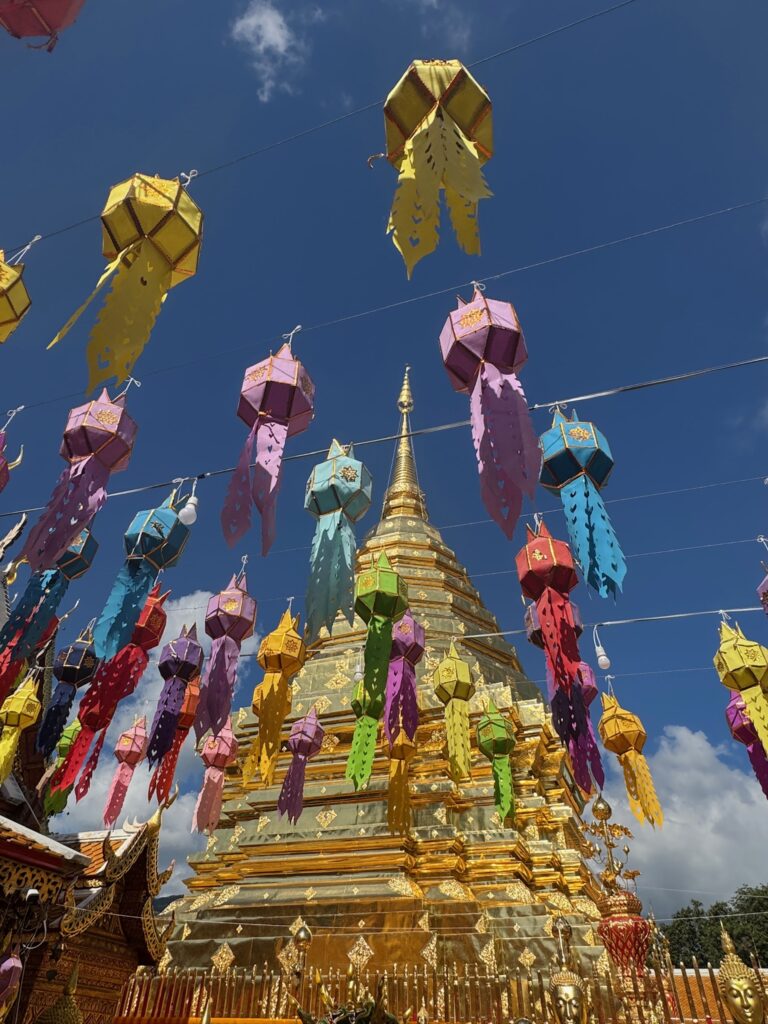
Chiang Mai is all about the temples by day, and the night markets after dark. There are three incredible temples we can walk to from our apartment in the Old City, and multiple others we make trips to see in coming days (Doi Suthep in the hills overlooking Chiang Mai being the highlight):
The first meal I tried in Chiang Mai was this unusual breakfast of Hot pan fried egg: I can’t say that four fried eggs with a liberal dusting of corn flakes was what I expected to be eating, but it went together quite well. Perhaps this is because at a breakfast buffet many of us would happily start with cereal and then move to the egg station, and at some point end up with cereal and eggs in our mouths. So it felt somehow surprisingly familiar even if I’m not in a hurry to try it again.

The tom yum reaches its zenith here at a small family-run restaurant called Mat’am Chiang Mai. It is located opposite a small mosque (Chiang Mai is where many Chinese Muslims have settled, so there is lots of halal food choice). This time it’s chicken tom yum rather than prawn, but it’s perfectly balanced: so spicy it makes your heart sing and then the other flavours come in distinctly yet also blend together in perfect harmony.
Here it was accompanied by an egg roti with condensed milk. Now, I like eggs, I adore roti, and I certainly loved condensed milk as a child … but put together, the whole thing was utterly vile. Talk about going from the sublime to the ridiculous!

The particular speciality of Chiang Mai is a laksa-like soup called Khao Soi, a coconut curry broth with egg noodles and usually chicken. I hadn’t realised before now that sometimes I do need a base level of spice in my food. I’m not a spice head (jalfrezi is my level with Indian food) and heat certainly isn’t required if I’m eating Italian or even Mexican food. But for Thai it appears to be a key requirement for me.
Often I found khao soi too sweet for me, but this place nailed it as there was that pleasing spice kick too:

One of my YouTube wormholes is watching Anthony Bourdain arriving in some South East Asian city, jetlagged and hungover but instantly reviving at the sight and sounds and smells of a food market in Indonesia or Laos or Malaysia. I always thought food markets would be my idea of heaven: acres and acres of stalls with simple well-made dishes using fresh ingredients and quick cooking at every corner.
But the reality is that in many instances, they turn out not to be quite the endlessly varied paradise I imagined. Often it is the same food being offered over and over again without a lot of variety. I thought my appetite for food would never be satiated in these places, but it’s surprising how full you feel walking around them before you’ve even eaten anything!
There were exceptions. Chatuchak in Bangkok is the world’s largest weekend market with over 200,000 people shopping there every Saturday and Sunday. There was lots of variety in terms of the food, to be fair, cuisine from all over the world, and some interesting-looking places only opening up as we were leaving in the evening. But a lot of the same types of desserts and drinks were on sale and they all looked cloyingly sweet. Virtually every stall selling clothes, handicrafts, and ornaments was identical to the stall twenty yards away offering the same type of goods.
On another night we did get a cab nearly an hour out of Bangkok to visit the Ramkhamhaeng food market, which was chaotic but offered lots of variety with stalls all selling halal food, including duck and lots of fish.
And one night we did walk down Bangkok’s infamous Khao San Road, with its stalls offering tourists the opportunity to get more protein into their diet by sampling scorpions, grubs, frogs, beetles, worms and grasshoppers. And no, we didn’t …

In Chiang Mai the city comes alive at night, with food and clothes markets dotted all around the centre of the city every evening, the busiest being Anusarn Market and Kalare Night Bazaar. They also have Wu Lai Street, only open on Saturday nights, which is a nearly mile-long strip with vendors either side, and which takes about three hours to walk up and down. On Sunday nights they have the busiest night market in Chiang Mai, Thae Phae, which consists of over 2km of stalls.
Any city that is not too busy, has good weather, and which involves walking, food, and shopping, is always going to be winner in my book. I went to Thailand expecting to love Bangkok, and left calculating how much it would cost to retire to Chiang Mai instead.
We were also very fortunate that back in November we had the opportunity to go to Vietnam. We had initially pencilled in visiting Vietnam, Thailand and Cambodia in one massive spree at Christmas/New Year. But when Mahnaz’s good friend, Mui, who was born in Vietnam, told us that she wanted to come and see us but also to go to her homeland, it seemed a good idea for us to visit Vietnam as a group. And so it was that after Mui, her daughter and her sister had spent a few days in Bali, we all flew to Hanoi.
When I was growing up as a child of the Eighties, Vietnam always held slightly negative connotations. Images of the American occupation, My Lai, and war films, were my immediate associations, and even in my twenties when I was travelling it wasn’t on my radar and seemed a slightly isolated place. Of course now it is a hugely attractive travel destination for anyone venturing into this part of the world.
It was quite daunting reading up on the country beforehand. Vietnam occupies almost the entire eastern coast of the mainland of Southeast Asia. It has the 16th biggest population in the world. There are so many places to see in the North (Ha Noi, Sapa, Ha Long Bay, Mai Chau, Ninh Binh), the Central area (Da Nang, Hoi An, Hue) and the Southern lowlands (Saigon, Phu Qoc, the Mekong delta, Da Lat). Travel writers were recommending a dizzying array of motorcycle tours, beach resorts, mountainous areas, and the incredible cities of Hanoi and Saigon (the latter is officially known as Ho Chi Minh City or HCMC). My manager went to Vietnam with his family for two weeks last summer and they had their best holiday, and other advice I saw suggested that anything less than three or four weeks would not do the country justice.
This is where the principle of ‘slow travel’ came in. We decided to be as present as we could and accept that we would not be able to visit every place we wanted to. We could have flown to the South and seen HCMC, but we focused on Northern Vietnam, which meant Hanoi, one bit of luxury – an island cruise in Ha Long Bay – and then whatever else we could arrange (which ended up being time in the cold, mountainous area of Ha Giang). We considered the motorcycle trip from Hue to Hoi An, but as well as being prohibitively expensive we felt we would not fully enjoy it if we were up against the clock. It was a wise move as the very rainy weather at this time of year had rendered parts of that route quite hazardous.
One of the joys of life is being able to explore a new city on foot that you never thought you would ever see. So the Saturday and Sunday tramping around Hanoi was just joyous. It felt so different to Bali as there were actually pavements – the novelty of walking! The French influence on the design of the buildings and roads was clear, at times if felt like walking in grand Parisian boulevards that had been transplanted directly into South East Asia.
We had breakfast in a café where a plain croissant (which we had confirmed as being vegetarian) arrived with ham in the middle of it (“What do you mean, sir, you don’t want the ham?”). The ladies ordered soursop juice, a fruit which when blended tastes yoghurty like lassi, but with a sharp fruity tang at the end. If I’d grown up in this part of the world, I am sure I’d be a devotee.
I had to order the classic Vietnamese drink of egg coffee:

I knew it was a Vietnamese delicacy but had forgotten what it actually looked like so when ordering I did have visions of coffee with some raw egg in it. In fact, it was black coffee with a foamy, slightly thick, almost custardy topping, made by blending egg yolks with sugar or condensed milk. I wasn’t sure how to drink it which meant I didn’t mix it together as I should have done. Basically I sipped sweet custard followed by the shock of bitter black coffee. That will sound either appealing or appalling – but it was really nice when mixed together.
We visited the presidential palace and museums, and the temperatures made it an absolute pleasure to walk around. We went to the world-famous Train Street, a small, colourful, twinkly street flanked by cafes and houses but with a live train track in the middle. We had just missed an early evening passenger train, so returned an hour later as the schedule meant we would be able to see two trains within minutes of each other. It is perfectly chilled and relaxed until two minutes before a scheduled train comes through, then the local shop-owners whirl into action in a well-practised manoeuvre, moving tables and chairs, insisting on everyone tucking their legs and arms in, making sure beers, teas and egg coffees are beside or behind. And then the huge train trundles by. I know that in London I will see four or five trains a day whizz past a Weaver Line platform, but it was undeniably thrilling to be sitting trackside as it all happened. Some tourists left bottle tops on the track so that they could take a flattened one as a souvenir, whilst others were more adventurous and propped their phones on the track so they could film the experience of the train coming through at ground-level. The height of the train meant that there was minimal chance of damage, though I will confess to a bit of schadenfreude hoping someone ended up with a mangled wreck of metal.

We packed a lot into the weekend, spending time around the Old Quarter and Hoan Kiem Lake which is considered the historic heart of the city. On the Sunday we had breakfast around Truc Bach Lake, and had to try the banh mi, the sandwich which may be Vietnam’s most famous dish. It was brought to the country by the French colonisers, and consists of a baguette filled with meat (often pork or chicken), pickles and vegetables. Mahnaz found a vegan café that did them and the bread was especially light and airy.

We went to cafes and restaurants, museums and pagodas, had massages, and enjoyed lots of shopping. Hanoi is heaven for any football fan as the fake football shirts are incredibly good. There are concerns about the morality of the fake shirt industry amidst their links to organised crime and sweatshops, but I confess those concerns didn’t weigh too heavily on my mind when buying the shirts. Four in all – Liverpool, Germany, Colombia and Japan – for a total cost of £40 (in the UK it would have been 9-10 times as much). One drawback is that the Colombian shirts all had the name and number of their most famous player James (pron. Ham-eth) Rodriguez. I’m a little bit too cool old to be wearing shirts bearing the names of players thirty years my junior, but I had no choice, although having ‘James 10’ on the back makes me look like a little boy called Jimmy excitedly celebrating his tenth birthday.
The Hoa Lo prison was particular memorable. Hoa Lo means “hell hole” and it is located in the French Quarter of the city. It was infamous for the brutality of the French towards the local populace during colonial rule, and later the cruelty of the North Vietnamese towards the American POWs (including John McCain). What was inspiring was seeing how the Vietnamese and Americans became reconciled after the conflict ended, with remarkably little lingering malice, understanding in their shared humanity that they were pawns in an illogical war, young kids attacking innocent people for reasons they didn’t really understand. I was fascinated when we went to Japan about their enduring relationship with America given the way WW2 ended, but I was not expecting the Vietnamese to be so welcoming of the Americans almost as soon as hostilities had ceased.
Given we had Monday-Wednesday free before having to be back in Hanoi on the Thursday for the cruise to Ha Long Bay, Mahnaz made the very wise decision for us to head off into the mountains nearer the Chinese border. In days gone by, we would have undoubtedly gone for a more touristy option, but on the advice of our friend Siobhan we went to a homestay in the Ha Giang area.
Ha Giang is becoming more and more popular with tourists, especially for the picturesque Ha Giang Loop, a winding road trip around the region that takes 4-5 hours on the back of a motorbike. It affords glorious views of mountains, canyons, lakes and rice fields, but that loop will have to wait for another time for us.
Instead it was a half-day journey from Hanoi to Ha Giang via luxury bus. Now a luxury bus – as anyone who watches Race Across The World knows – basically contains sleeper compartments and you can lie down flat and sleep … in theory. In practice, it wasn’t especially comfortable but the early start meant we were all knocked out and did manage some shut-eye.
I made an embarrassing rookie error at one of the stops on the way. It was a large covered market area with lots of people milling around stalls selling fruit, sweet treats, crisps, and hot and cold drinks. I bought some bananas and soft drinks, and decided to get two tasty-looking doughnuts for the group to share. I approached to pay holding my remaining cash in my hand, and after discussing prices – and failing to understand each other – the lady simply swiped my cash and indicated: “Next!” Ultimately I ended up paying a tenner for some bananas and a couple of drinks as the enticing doughnuts turned out to be leathery and utterly inedible. In my defence, I had been woken up as we pulled into the stop so I wasn’t fully compos mentis, but Lesson Learned: no matter how busy it might be, wait to establish the price before producing the cash.
We arrived at Mr Thien’s Homestay and it was a different world altogether from Hanoi. For a start it was cold and wet. Mr Thien and his wife hosted us and a couple of other groups of tourists at their homestay in a small, mountain village near Ha Giang. The rooms were made from bamboo and wood, and were very basic, with thick blankets to keep out the cold. They also cooked breakfast, lunch and dinner for their guests, and traditionally it is the men who do the bulk of the cooking in these areas, apparently. This meant massive spreads tailored to tourist appetites. So, as well as pork and chicken or beef dishes, there was always a seafood option, and lots of veggie dishes too (tofu, lots of garlicky and gingery greens, sticky rice, omelette).

We needed all that protein the next morning (breakfast: fried eggs and salad in a baguette) when we went for a guided walk in the mountains. Although the rain was light it did not let up all morning, but it did not stop us from enjoying mountain scenery that was breathtaking. We walked all morning up and down steep roads and hills and through streams and rivers, stopping in one remote mountain outpost to have tea, and meeting the charming lady pictured in the blog’s main image.
She was chewing some combination of areca nuts, betel leaves and/or tobacco. Any permutation of these can result in that familiar black or red staining of the teeth. At the women’s museum in Hanoi we had read about how young women would blacken their teeth in days gone by as this was considered more appealing than boring, shiny, white teeth. The chewing provides a lightly narcotic effect which is clearly powerful enough to be worth the discomfort of displaced jaws and missing teeth that often comes as a result of the addiction.
We came back for lunch then went out again in the afternoon for a drive around some of the motorbike routes, which included a pitstop at a coffeeshop which was full of bikers and their guides, and which also sold the traditional coloured scarves for which Ha Giang is famous. We stopped off at another homestay for dinner, and an equally lavish spread cooked by the man of the house and his teenage sons.

It would be pretentious and false to say that the homestays provided a fully authentic Vietnamese village experience, catering as it does to (primarily) Western tourists. But it did offer a very different perspective, a simplicity and a humanity. Being in the mountains and the simple villages where agriculture has been a large part of their way of life for centuries represented a real change of pace and setting. And at least the money went directly to the local homeowners, who were incredibly welcoming and generous. It felt different to Bali where so many homes are owned either by foreign investors or by local Balinese who have designed them as European-style villas.
Two fantastic countries to have visited, and I’m glad that we travelled slowly and savoured every step.
Anisa’s “words of wisdom”
Vietnam : Beautiful mountains and holy temples. My highlight was: Spending time with Auntie Mui and Sadie, and going to a capybara cafe in Hanoi.
Thailand : A wonderful country filled with beautiful wildlife and bursting with culture. My highlight was: Being in Chiang Mai for New Year and seeing the lanterns and fireworks. And going to a paint cafe in Chinatown in Bangkok, where I got to paint some cake!
Mahnaz’s Photo Gallery (Thailand and Vietnam)
A brief update first!
We have moved house 3 times over the past month, and it is exhausting – not uncommon for new families of the Green School. What a chaotic start to the year. Sibang – the village which holds the Green School – is seeing a huge increase in the number of properties being built by locals as well as foreigners. As a result house prices have been pushed up as demand has increased – and this fluctuates depending on the season. In the meantime, large parts of the green belt land which surrounds the school is being removed and the lush forests and natural habitats are replaced by villas and occasional eco-friendly houses. It is inevitable – no matter how much this pains me. Gentrification has also kicked in, which meant our landlord increased our rental, so we had to leave. If you know me, you know I get to know my neighbours. Well, the house where we lived was in a little street (“gang” in Bahasa) with only a couple of other houses. One housed some wonderfully warm and welcoming people, including an English teacher in a school in the city of Denpasar. We were speaking and I mentioned that we were looking for somewhere to live. She said her aunt’s house was available across the lane from them. We had a look but Suleiman found it too dark. I was fine with it and it was way more affordable than we had found with other houses in the area – most of which are purpose built for return of investment and GS parents.
We decided to move in after Suleiman viewed it again in the daylight and felt he could live with it. We met the landlady who lives in a city near the coast. She was one of the coldest Balinese women I have met to date. The house was very basic. Our neighbour’s family had brought wardrobes, bedside tables and a desk for us as well as some other bits and pieces to make the place liveable. This was all intended to come out of the first month’s rent, but the landlady pocketed the lot and got her sister who lives opposite to buy everything. Along with the month’s deposit we had until the end of January to pay for the remaining 5 months. They said they would do some things for the house when we paid – like get the hot water fixed, and install mosquito netting on the beautifully ornate wooden doors.
By the time we got to the end of January, we were due to pay the rest of the rent, but we were having second thoughts. Suleiman and Anisa hated the wild dogs and cockerel outside whose barking would wake us up several times a night. Suleiman couldn’t get over how dark the house was (no glass, just wooden slats in the walls). And the hot water still hadn’t been fixed.
We had seen another few properties, all of which had been negotiated down significantly (one where Astrid’s wonderful Turkish haggling negotiation skills were incredibly valued!). We were left with 2 affordable options, which we were incredibly grateful for. After weighing up the pros and cons, we decided to stay at our laundry lady’s rental property. It was up for airbnb but she really wanted to help and offered us a price we couldn’t refuse – with some home help thrown in. We have Hopey with us and we are beginning to settle in. An electric scooter was also thrown in 🙂
Oh, and the other move which we made was when we had been in “The Dark House” for a few days. We had the opportunity to dogsit 2 of the most beautiful poodles in Canggu, as a friend of a friend urgently needed to go back to Australia. Canggu is an area which boasted some of the most beautiful rice fields in Bali many years ago, but is now over-developed and has had issues with flooding. Anisa and I were so desperate for a hot shower that we all agreed to dogsit for what turned out to be 9 days. The house was glorious, the dogs friendly and utterly gorgeous, but the commute each day by taxi was exhausting. Anisa and I went in to school each day and were out like a light by 9pm.
Just 5 months to go now before the end of the school year and we return to Londinium. I am really looking forward to seeing family and friends.
I have shared some pics of our travels below. We hope you enjoy them. It was so lovely to be with Mui, Sadie, Ruby, Atiya and Dave on our travels! Thank you for having us to join you!
Do comment to let us know you’ve had a read of our travels so far!
With love, always.
Mahnaz
Vietnam


Thailand


6 Comments
Oh my! Another world.An overload on the senses. Why on earth would you want to return to London? Love you and miss you.
Awww Jean! I miss you and love you too! See you in the Summer! xxx
Hi Jean!
London is wonderful at most times of the year! (Spring, Summer especially, and the run up to Christmas and New Year) – it’s just January and February that drag a bit.
I’m doing another quiz at the school in a couple of months, and again will have to exclude most of the types of questions I would use in the UK as all the cultural reference points are different for an international audience.
Say hi to Alan x
Reading this whilst eating some butternut squash soup! Both activities are delightful. Hope you are enjoying the new place and your remaining months there. June will come around before you know it . 🫶🏽
Butternut squash soup is good, Shazia. Especially with a nice piece of bread.
But does it make your heart sing? I didn’t mention on the blog but harira is probably the other soup that I would order in (Middle Eastern) restaurants.
Not saying there aren’t good soups, just that there are very few stellar ones. X
Thank you, Shazia. Yes – time is flying xx