


Mythical Soup
20 January 2026
Anisa
I got my first job at our local restaurant/cafe called Baja Deli. My job was to learn about how to input info into the cash register and to basically be the cashier in their cafe store on a Friday night when it was a comedy night. I worked there with my friend Samara and it was super fun!
When it was my 14th birthday i really loved it and I’m so grateful to all of my family and friends for being so generous. I went to the mall and did karaoke with my friends and then i got my final present at the very end which was Airpods which i have been wanting for sooo long!

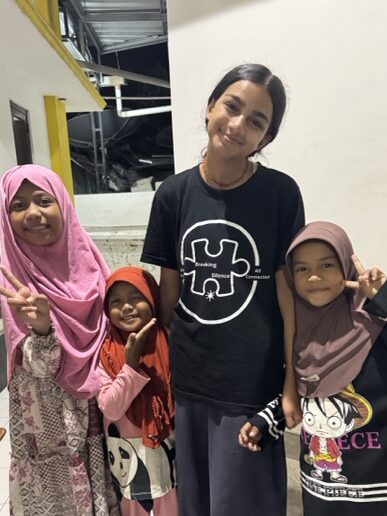
After my event called “Breaking Silence” with my speakers and guests
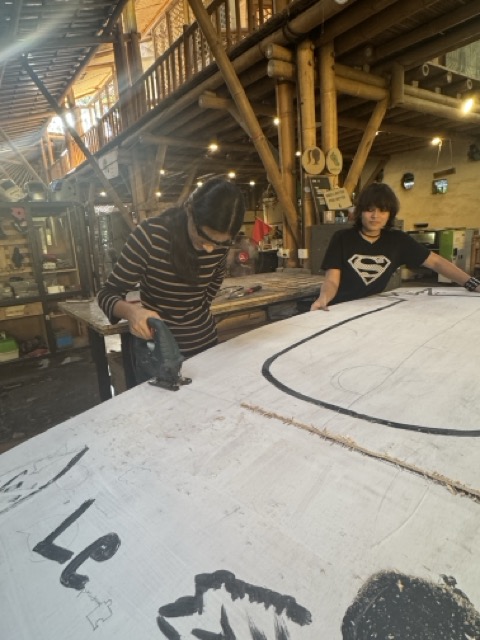


My Quest was really stressful, but SO worth it in the end, because i know that i changed some peoples opinions about discrimination and hopefully helped to prevent it later on in the future. When people ask me, “Oh, whats your favourite part about middle school?”, i have to say either Quest, or the graduation party after Quest. Quest because it was nice presenting in the end and it was quite a big project and the graduation party because the food was SO yummy and it was fun to just explore the area where the party was held on the other side of the river.

Now on to my child: Hopey. Hopey was genuinely one of the best things that happened to i think all of us in Bali. However, one Saturday morning my dad was going to get gas for our cooker, Hopey followed him there and ran across the road, getting hit by a car. Luckily she survived, but sprinted away and we couldn’t find her for a day (but it felt like a a WEEK!) I was crashing out, but when my friend came with me to help look for her, we found out that a farmer decided to look after her when she went to his farm and Hopey was back at home. As soon as Hopey came home, we called the vet (who said she was fine) and took her to the beach with her bsf Raiju.


After i finished Quest, we went for a trip to Flores in Indonesia, which was so fun and honestly one of the best trips that we’ve had since leaving the UK. Basically, we were on a boat with around 10 other people and we would just sail around the sea and do snorkeling trips and hikes. Free diving and snorkelling have definitely become two of my favourite activities.
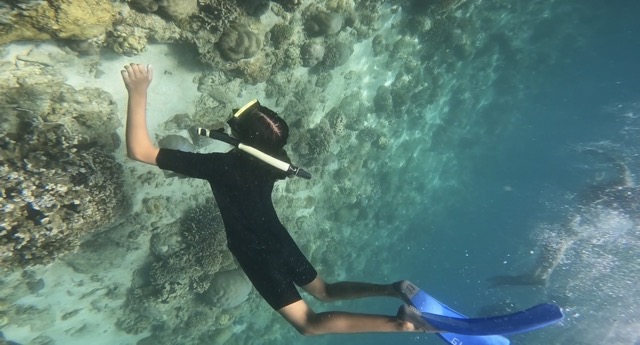

One time when I went snorkelling my hair was in this peculiar hairstyle and after coming out of the water when I went to shower I tried brushing my hair and the world’s biggest knot was in my hair and it genuinely would not come out and I spent two hours aggressively brushing my hair while clumps of hair just fell out of my scalp .
There was also really delicious food there so that’s good . Off topic it was really sad to say goodbye to Hopey but we’re going to see her soon when we go back to Bali to pick up our things so I’m very excited . Leaving Bali, the hardest thing was definitely packing and goodbyes. I know the packing part is very unexpected but it’s true because I had so much stuff that was so hard to just pack away.
In Malaysia, I live right across my school and I really enjoy it there. I like most of the teachers and all the students in my class are really nice . Only one downside which is how much homework and take home tasks and essays and tests we are given there. I am not joking when I say that in my first week I had six or seven assignments . Also, the new Spider-Man movie is really good. I watched it twice! We also went to the only iMax cinema here to watch The Odyssey which was also good. Also this is random but I really like studying now!! I study for so many hours a day and I’m getting much better at my subjects.
Suleiman
Our last blog post was back in early February. At that point, the US and Israel had yet to attack Iran, Keir Starmer was still the Prime Minister, and Zendaya was someone who was once in “The Greatest Showman” rather than being every single place you look. The world is changing so quickly every day, although England’s exit from the World Cup shows that perhaps some things are forever destined to stay the same. (What on earth were you thinking, Thomas??)
The original plan when we arrived in Bali in January 2025 was to stay for one year, but we ended up extending by another five months because Anisa had the chance to complete Quest, Green School’s major middle-school project. In certain grades, students develop a project and present it to the school, their families and the wider community: Year 5 students do Footprints, Year 8 students do their Quest, and graduating 18-year-olds present their Greenstones.
The projects, especially in the older grades, are about making a tangible change: doing something for the environment or sustainability; building something to solve a problem; working with charities or the local community; or helping to change hearts and minds.
Year 5 students spend a term working on Footprints before giving a five-minute presentation. Year 8 students spend two terms on Quest and present for 10 minutes, while Year 12 students work on their Greenstones for the best part of two years before presenting for 20 minutes.
We arrived initially when it was halfway through the school year, but after watching the Grade 8 students present their Quest projects that June, and the sense of occasion at the Sangkep with family and friends travelling across the world to be in attendance, we felt we could not let Anisa leave in December without giving her the same opportunity. Hence extending our time there.
In a school with continuous assessment but no meaningful exams until after the age of 16, it is easy to see why Quest assumes such importance for Anisa’s grade. It becomes everything. Although work formally begins in January ahead of the June presentations, many students are already thinking — and stressing — about it from the start of the school year. The school handles this well: teachers go far beyond the call of duty in supporting and mentoring the students, while still giving them room to make mistakes, pivot when needed and develop through the process. Some parents worry that, even three months before the presentation, their child still has no clear idea what they want to do whilst seeing classmates already researching, interviewing, filming or designing. But that is all part of the process, and somehow it comes together at a pace as the big day approaches.
Anisa’s project focused on discrimination. Two weeks before her presentation, she organised and hosted an event at the school where six guest speakers shared their personal experiences. 50 attendees moved between groups and heard from three speakers each, talking about gender-based discrimination in the workplace, ageism, racism, religious discrimination and specific learning difficulties, including their impact on education. I learned a lot I had not known before. The speaker on dyslexia made the strongest impression on me: I had assumed it was always a form of word-blindness, rather than — in his case — being slower to process words and letters he could still read accurately. He explained that even some good friends occasionally thought of him as thick, and he would often fail exams because he completed only half the questions, even though the answers he did supply were all correct.
Anisa used the event as the basis for her presentation on the big day. Two days were set aside for the twenty-four students in her grade, with Anisa speaking second on day two. The first speaker that morning was a Balinese boy whose presentation on Balinese art we already knew to be remarkably polished and mature for his age.
She was not daunted, though, and stepped out in front of the audience with a big smile on her face that belied any nerves. She spoke with real assurance and the hard work she had put in to master her speech paid off. Needless to say, our pride was off the scale:
Some of the students struggled more than Anisa to find motivation, or to implement their ideas or to express themselves with confidence. But those challenges — and the way they adapted or overcame them — will hopefully arm them with life skills that matter as much or more than the conventional academic skills they are also developing. Even experiencing the unique terror of public speaking, then coming out to applause and cheers and leaving to an even louder ovation, will stand them in such good stead. The students celebrated with a fantastic banquet (arranged by the grade 8 parents) and a later graduation dinner, and it was a wonderful way to see out the school year and Anisa’s 18 months in Indonesia.

Earlier in the year, we celebrated Ramadan in the last of the three homes we lived in during our stay in Sibang. After our previous landlord opportunistically upped the rent, we had downsized to a simple two-bed house. It lacked the pool that so many Balinese properties aimed at foreigners always feature, and it was a twenty-minute walk to the school rather than ten. But it was a lot quieter at night without the barking of stray dogs, and it did have a lovely upper terrace where our dog, Hopey, generally slept at night. And one added bonus of our new home was the house number. As a fan of the brilliant TV show Inside No 9, it made me inordinately happy.

A particularly great Ramadan memory was on the first Saturday, when we invited people over for a potluck Iftar (breaking of the fast) that doubled as a housewarming. Hopey had to be tied up downstairs, which she did not appreciate in the slightest, because she was still at the stage where she would launch herself at any unattended food. After dinner, one of the guests played some Sufi music, and a friend of Mahnaz’s led a group whirling circle, showing us how to whirl safely for minutes at a time.


Other dinners during Ramadan were memorable too, and Mahnaz helped organise the school’s second Ramadan event, following last year’s successful debut. Around 50 members of the community came for the food (if we’re honest) but we also spoke publicly about Ramadan: what it does to our bodies, from lack of sleep and a shrinking stomach to constipation (all the good stuff) and why it can be such a valuable month of reflection and pause.
Talking of pause, the end of Ramadan again coincided with Nyepi, the Balinese holiday of 24 hours’ complete silence: no lights, no travel, no talking, a day of total seclusion. As in the previous year, we had to make the tough decision to leave Bali before experiencing Nyepi, because we wanted to celebrate Eid on the Indonesian mainland, and we would not have been able to fly to Jakarta or elsewhere in time unless we left before Nyepi.
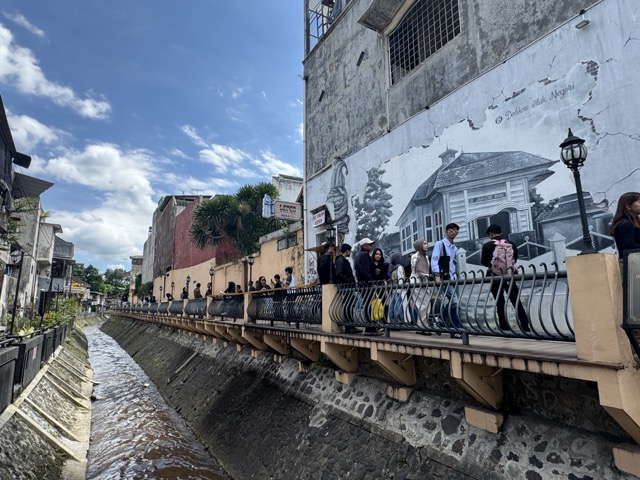
Java was fantastic: recognisably Indonesian, but very different from Bali and more chilled in the main. We did not go to Jakarta which — from what friends have said – sounds anything but chilled and literally sinking under the weight of its population and infrastructure. But we did visit several other cities. We centred our trip on the amazing city of Yogyakarta, with the highlights being Mahnaz’s birthday meal high in the hills overlooking the city, and visits to the ninth-century Unesco sites at Borobudur, the world’s largest Buddhist temple, and Prambanan, a huge, soaring Hindu temple.


We took the train east to Malang, where Afi – a friend who worked at KulKul farm restaurant in Sibang – showed us around her home town. Mahnaz said it was perhaps her favourite city in all of South East Asia, with its lovely historic centre, old colonial buildings and vibrant cafe culture.
We were briefly in the touristy city of Surabaya, known for its shopping, but because I was working while we were there my only real recollection is of a Brazilian barbecue meal at a churrascaria called Chamas. And yes, I know it is always about food with me. They’re ubiquitous nowadays but it was our first Brazilian barbecue and the meat kept coming and coming. What we had was very good, admittedly, and the charred pineapple with cinnamon sugar was a particular delight, but it was simply too much excess. Even now the thought of going again makes me feel queasy.

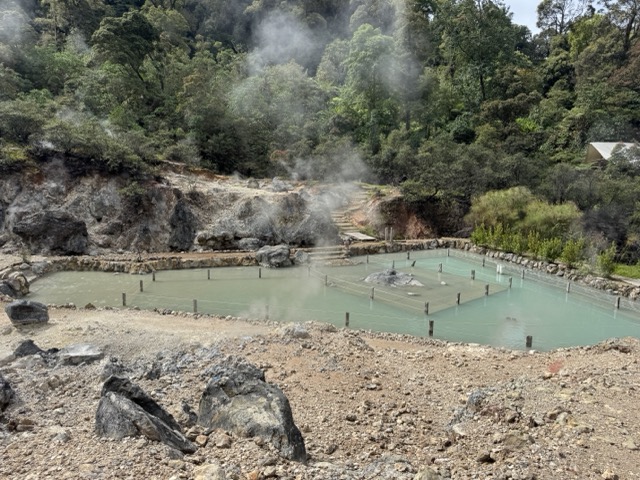
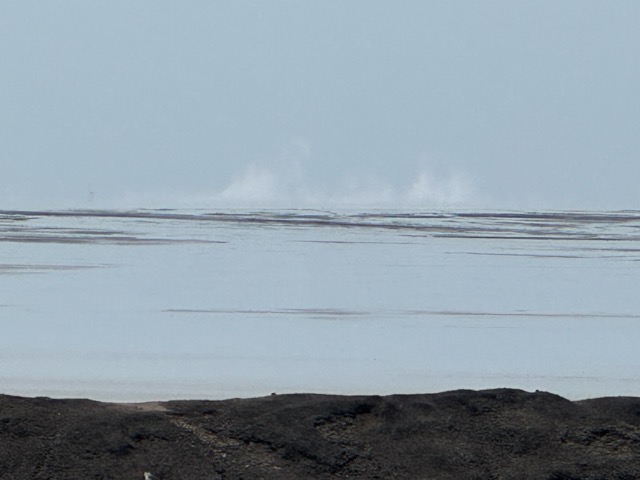
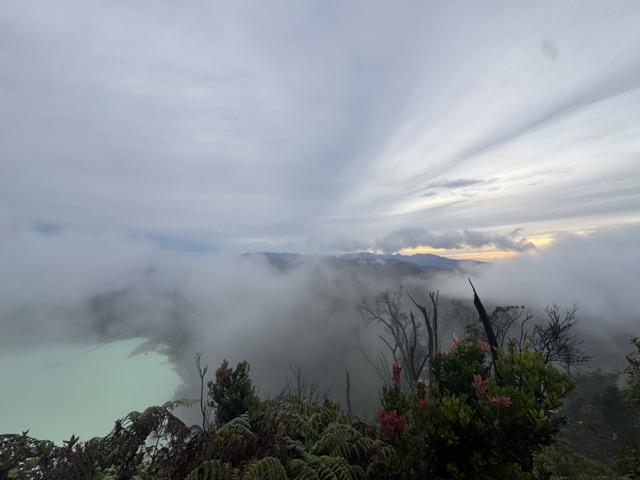
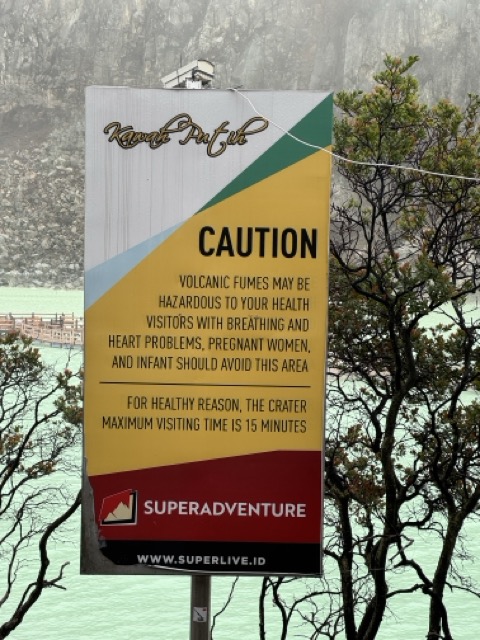
We spent time in Bandung which was also great, the standout experience being a freezing early morning mountain walk to watch the sun rise over Kawah Putih (White Crater) lake, followed by a swim in the hot springs.
Back in Bali, we have had some interesting experiences with healthcare. Expats tend to take out expensive medical insurance for emergencies, but there is no real equivalent of a GP for ongoing care. If you need something treated, you contact a clinic. One day, Anisa woke up nauseous and vomiting; I messaged a clinic on WhatsApp, and within an hour they had visited, checked her over, prescribed medication and fluids, and sent us a bill for £25. I had similar positive experiences with clinics treating an ear infection. Eventually the infection proved so persistent that I had to message a local hospital (on WhatsApp again) and secure an appointment with their ENT specialist the next morning. I took a 15-minute Grab bike to the hospital, saw the consultant, had my ear washed out, got antibiotics and was done within the hour for £40. Follow-up appointments were £20–30 apiece.
I remain deeply grateful for the NHS and the principle of care that is free at the point of contact. At the same time, it was striking how easy it was for us to get appointments so quickly, and how different that felt from the hurdles people back home often face when trying to access care. Of course, being able to use those services at all depends on having the money to pay for them. The average Balinese salary is around £150 a month, so many local people either rely on traditional remedies and practitioners or leave conditions untreated. That is a sobering reality, and I am conscious of seeing it from a position of privilege.
If I am ever in foreign climes, I love to attend a football match. Indonesian league games tend to be played late on Monday nights when I am working, but when one fell on Easter Monday I was free to go as it was a UK bank holiday. Interestingly Bali has a public holiday for Good Friday but not on the Monday. They have the Ascension Day of Christ approx. 40 days later in mid-May. Anyway, I took a Grab to the 15,000-capacity Kapten I Wayan Dipta Stadium in Denpasar … and found it eerily quiet. Bali United’s supporters are known for being rowdy and usually fill half the stadium, but the streets around the ground were so calm it felt other-worldly. When I was dropped off, I was personally greeted by several police officers and quickly understood why: Bali United were serving a ban because of their supporters’ behaviour at a previous game. So no fans were allowed in whatsoever! I walked over to KFC next to the stadium, had my dinner, then got a cab back home, and woke up in the morning to the news that Bali United had played in a completely empty stadium .. and won 6-1!
So when the final home game of the season was scheduled for a Sunday in May and with no ban on fan attendance, I was especially keen that we all went. The ticketing situation was a bit unclear with many advising you could just turn up on the day, but luckily our friend Prashant had been a few times and advised us to buy them in advance. Tickets were 70,000 IDR each (£2.90), and the seating was unreserved. The stadium eventually was about half full, with the opposite stand and one end of the stadium basically cordoned off. Lots of women and children were in attendance, though I don’t think there were any visiting fans from the mainland. I’m always fascinated by how football traditions vary from country to country. In Spain, for instance, you see mounds of pipas (sunflower seed shells), which people chew and spit out by their feet. In other parts of Europe it tends to be meat-based sandwiches, crisps, fruit, or of course – as we have in the UK – pies and hot dogs. Here, at half-time many fans left their seats or even the stadium entirely to go to the vendors outside and get noodles or satay or nasi goreng . Unfortunately nearly all returned with their food in clear plastic bags 🙁
The football was not always the slickest, but there was a pleasing amount of needle between the players. I was surprised by how seriously some of the crowd took every challenge and tackle, despite there being absolutely nothing riding on the game as both teams were mid-table. The language from the fans was in very fast Bahasa but punctuated with the odd recognisably English swear word, which made me feel at home.
The Bali United fans even did the Poznan: the dance where you put your arms on your neighbours’ shoulders, turn your back on the play and bounce up and down. As the final whistle approached, flares filled the air with so much smoke that the match had to be paused for several minutes. Despite Bhayangkara looking the stronger side for parts of the game, Bali United ended up winning 4-1.


Towards the end of our stay in Bali, my health and fitness was as good as it has been for a long time. I was going to the gym 5-6 mornings a week and I even attended – and started to love – Yoga and Pilates classes. I have generally been immune to the charms of yoga, mainly as my formative experiences of yoga classes consisted of instructors wondering why there was this one person in the whole class who simply could not follow basic instructions or perform the simplest manouevres. They would then have to come over and forcibly move this person (name redacted to spare their embarrassment) into the correct position.
The community in Sibang have a Yoga or Yogalates class early in the week with Stacia, Pilates on a Thursday with Yuki and Yoga on a Friday with Rajiv, who are all excellent instructors. I especially enjoyed Pilates, which took place in the school’s yoga shala by the river. I would arrive as school kids aged between 5-9 were just finishing their yoga class, which I never failed to find genuinely affecting and the kind of thing I wish more schools could offer. The instructor, Yuki, is a former Green School graduate and was very patient with me. The class was relaxed with 8-10 attendees, and I slowly started to enjoy it and find it genuinely transformative. I realised how much I had to learn about movement and flexibility. Even basic hip extensions and rotations were beyond me at first, as is often the case for men whose flexibility is in the arms and chest rather than women where it’s all in the hips. But the classes began to make a real difference to my core and to how my body felt.

Coming back to the UK in the summer, it was that gym/Pilates routine that I really missed. My initial overconsumption of M&S chocolate-covered bourbons and custard creams (where have you been all my life?) did not help matters, but although we are no longer in Bali, I am pleased to be getting back into the swing of things at the gym and doing the strength work that is so important as I get older. Once we have settled, we also plan to go to reformer Pilates which Mahnaz has tried and raved about and which I expect to be even more effective (shoutout to Lucy Bourdon for inspiring Mahnaz!).
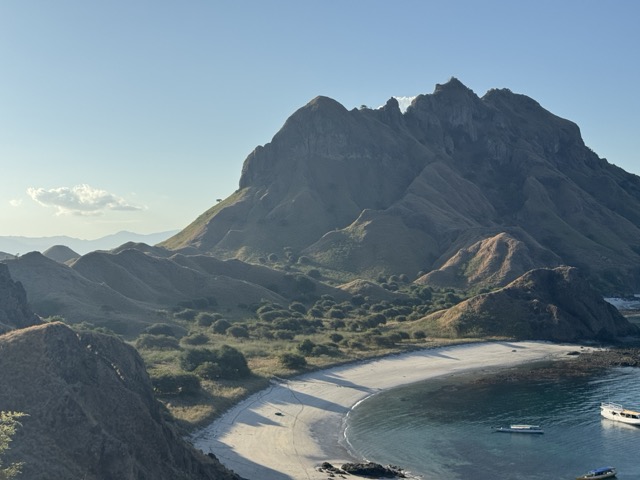
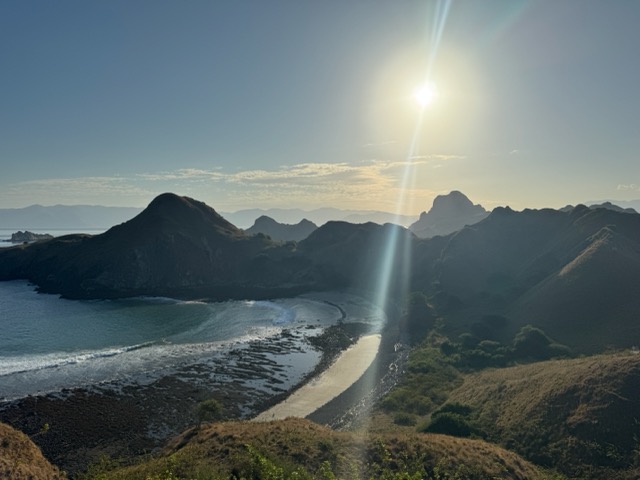
Our final excursion, after school finished and before we returned to the UK, was to Flores, a group of islands that includes Komodo, home of the famous dragon lizards.
Mahnaz’s pictures will, I am sure, convey the majesty and beauty of this incredible place better than my words, but we felt very fortunate to be there. We spent three days and two nights on a wooden boat with no Wi-Fi, alongside a diverse group of fellow tourists from the UK, Austria, US, Australia, China and Indonesia, with whom we bonded over long days of swimming and snorkelling.

The highlight was seeing the Komodo dragons and, for Anisa and Mahnaz especially, swimming among the baby sharks. They were not actually baby sharks; understandably, their mothers would not react well to humans being so closer to their offspring. We were told they were more likely to be reef sharks, perfectly content to swim among tourists just a metre from the beach.
Saying goodbye to Sibang was very sad. It has been a wonderful home for us over these 18 months. We settled very quickly, made many good friends and, as one fellow departee put it, we “found our tribe”: people who may have seemed totally different on the surface but who shared the same worldview and principles underneath. We were also conscious that the parent community, ourselves included, were guests in a place under immense pressure from outsiders and development. Some of what we saw — Mediterranean-style villas and padel courts appearing where land had been, and decisions that seemed to be inspired by taking a lot more than they gave back — sat uneasily with the kindness and community we experienced from so many others. Think of a world where every other person is a neighbourino like Ned Flanders (but without the homilies and cheesiness). We all saw one another every day at school, at our regular haunt of Baja café but also the other coffee shops and warungs, at yoga and Pilates, at the shops or at the gym, or negotiating the back roads and paths to these places. I’ve never been part of that before, and we miss it already.
It was especially hard saying goodbye to Hopey, our beautiful dog that Anisa rescued as a days-old puppy in the forest opposite our first house, and with whom we fell in love.


She adored living at Dede Home, and I took her for walks every morning or lunchtime. We would cross the main road at the end of our street, then head on the long road towards Green Village, a tranquil development of bamboo villas and houses, and down to the river. We settled into such a routine that I would know which blessings – the flowers, rice and biscuit offerings that the locals would put outside their house every day – she would eat and which she’d ignore. I could almost time her poos and wees, which were often in the same places and in the same order (wee at one spot, 45 seconds later a poo, and then a wee on the way back). I marvelled at how she would stick her nose into some fresh dog poo, trying to work out who had left the calling card. I confess I didn’t marvel at it at first until someone explained it was basically like dogs sending text messages to each other. They want to know who laid it and that’s the best way to find out (there is also no culture of picking up after dogs there). Sometimes we walked all the way to the school, which for me would take 15-20 minutes but with Hopey it would be an hour or more. That journey could be traumatic because there are so many wild dogs. Hopey was fresh meat, and they would notice her, and occasionally they attacked, which meant me picking her up and carrying her for certain points of the walk.
On one occasion, I took a detour past our old house on the way to a puppy play date near the school, and Hopey’s mum, Sophie, saw her. Sophie had effectively disowned her daughter as she was not able to bond with her post-partum, but having seen her other puppies all given away there was eventually a connection from mum to daughter. They were all over each other, and I could not prevent Sophie following Hopey all the way to the school. We could not take all the back roads as we had planned so had to walk along the main road instead. As I have mentioned in previous blogs, walking along the streets in Sibang is difficult because there are no pavements: at best, there may be a tiny sliver of brick, sand or concrete for single-file walking, while the roads are chock-full of cars and bikes. I had Hopey on her lead and had managed to keep her safe from traffic and other dogs, while Sophie lagged behind, trying not to lose sight of us. Near the main grocery store, Pak Kumis, I turned back to check on Sophie and saw her step into the road without noticing a large van coming up behind her. Bodywork met body as she thudded into the side of the van which sent her flying further than I would ever have expected a big dog could fly. She landed on her feet and then ran back down the road in shock. We learned later she had eventually made her way home, but it was quite traumatic for both of us to witness.
One Saturday morning a few weeks later, Hopey followed me out of the house when I needed to go to the shop at the end of the road to get a new cylinder of gas. She had followed me a couple of times previously but always stopped outside the shop terrified of the busy main road ahead. We were also used to letting her out of the house unaccompanied for a few hours at a time as the road we are on was quiet and she was always happy to play with her buddies at our end where it is all residential.
This time, though, she walked with me to the shop and then proceeded to continue to walk across the main road. It was momentarily quiet traffic-wise but my heart was still in my mouth as she successfully navigated the road like a veteran. I had only ever seen her cross this road when she was on the end of a lead with me, so maybe this was something she was used to doing when we left her to her own devices?
Once I’d finished paying for the gas I looked up and Hopey started to cross the road back towards me again. However, she was still clearly a rookie at this, because she did not look up or to either side at all. Barely had she taken her first nonchalant step into the road than a big car knocked her over with an ominously huge thunk of metal hitting muscle and bone. The lady in the shop screamed, and said: “Is that your dog?” I watched in horror as more cars piled up behind the one that had hit Hopey. I couldn’t see her as the traffic was obscuring my view but because it had all gone deathly quiet and the traffic had come to a halt, I could only imagine a scene of total horror in my head. I started to walk towards the scene of the accident, already anticipating how I would break the news to Mahnaz and Anisa, and cursing myself for not insisting Hopey go back into the house when she followed me out.
Just then, as I started to cross the road and peer round some of the cars, Hopey sprang back into life! I couldn’t see if she had any injuries, but the fact that there wasn’t any blood on the road was a good sign. She hared off like a sprinter ignoring my shouts, and with no visible limp. She turned left and disappeared down the long road to Green Village where we would take our daily walks.
I ran back home to tell Mahnaz and Anisa what had happened, and then we went out looking for her. We assumed she would not be far away, and was probably in shock and hiding somewhere quiet, on the assumption she was not badly injured. But there was no sign of her. We checked all her favourite places: where she liked to take shade, where she liked to lie down, where she adored drinking from the stream, and where her favourite plants grew. We called out to her constantly, but no joy.
We went back out along that route every hour, and asked the shopkeeper and our laundry to knock on our door if they saw her trying to make her way back. Through the afternoon and evening we kept searching, leaving some of her favourite food at different points along the way, but they were still there several hours later. Fellow members of the Sibang community were on the lookout, and some even came by on their bikes to help. We walked back to our old house in case she had gone in search of the familiar comfort of her first home, and Sophie saw us and jumped all over us, which was lovely. Later that night, I went out every hour calling Hopey’s name and hoping she would respond, but she did not answer.
The following morning, Sunday, we went out again to look for her. Along that route down to Green Village, large single-storey houses sit back on either side of the path. Some are buried behind undergrowth and are quite difficult to reach. We’d received message that some friends were about to join us by car to form a search party and comb a wider area, and while we waited Mahnaz noticed the owner of the first house on that road standing outside, some distance away. We ducked under shrubbery to reach him, and Mahnaz showed him a picture of Hopey. He matter-of-factly said that yes, a dog had come in yesterday and was still there. We walked over, and there she was! Hopey!! She was still a little shocked but thrilled to see us, and given I had genuinely thought we might never see her again it is fair to say the feeling was mutual. We had walked past this house multiple times in the previous 24 hours calling out her name and even though the house was tucked away she would have been able to hear us, so I’m not sure why she didn’t respond earlier. No matter, she was safe. I walked her on the lead back across the main road, and she was moving freely, and although it was relatively quiet, she showed no sign of being traumatised by crossing near to the scene of the accident.
We gave her lots of hugs and attention at home, and when the vet came and gave her the once-over he confirmed that incredibly she had suffered no injuries whatsoever.

Her rather crazy weekend was topped off by a puppy playdate on the beach with our friend Amita’s dog, Raiju, her best buddy. In the space of 24 hours she had endured the very worst experience and then the very best!

Saying goodbye to her was very hard indeed. We couldn’t conceive of bringing her home to the UK. Some of the community have brought Balinese dogs back to Europe, but the logistics are complex and expensive. She’s also a Balinese street dog, it felt right for her to remain in Sibang. Unfortunately, no-one seemed keen on adopting or fostering her, as people either had pets already or were looking for puppies only, of which there is never a shortage in Sibang. Eventually Mahnaz spoke to the couple who owned the shop at the end of the road from which I had bought gas on the day of Hopey’s accident. The woman in the shop that day was the owner’s sister, who had told her about the accident. The owner was already well disposed to Hopey, always making sure there was fresh cold water for her whenever we came back from our walk. Perhaps the accident influenced her thinking, because although previously they had mentioned a friend who might just possibly take Hopey she and her husband then declared that they would happily take her. We managed to see Hopey again just before we left and whilst she was jumping all over us we knew (and know) she would be well looked-after.

So, why did we end up not staying on in Bali?
Primarily, it was about education, the reason we came here in the first place. For all Green School’s virtues, we felt that children in the middle-school grades quickly realised that, without exams or a major project like Quest to focus on, there was little incentive to work hard and push themselves academically. Many took their foot off the gas completely because … well, why wouldn’t they? Anisa learned a huge amount from her Quest: project management, staging an event, public speaking and so much more. But academically, her English and Maths were sliding. Although the next couple of years would have been more academically focused, we felt Anisa would thrive in a curriculum that balanced Green School’s holistic approach with more conventional scholarly excellence: somewhere that was still rooted in projects, presentations, community and citizenship, but without the UK and US model of juggling 10 to 12 subjects in a system where single exams determine your future.
As the year progressed, Green School often talked about how AI is changing the world, and how the educational and working environments our children expect to enter in four or seven years’ time simply will not exist in the same form it does now. That makes critical thinking, problem-solving and vocational work that contributes to local and wider communities increasingly important — perhaps, in some cases, more important than a university degree.
We were looking for something that sat between Green School’s project-based learning ethos and the academic rigour of the UK and US systems. There is nothing quite like the Green School, but we felt the International Baccalaureate curriculum seemed to tick many of the boxes. It is weighted more towards the academic side of the equation but we had heard good things from others, and we found several schools in Malaysia — a country we have grown very fond of — where IB schools were more financially realistic for us than similar options in the UK. So that is how we have ended up in Penang.
We also had serious concerns about the Green School’s leadership. Many of the teachers left a very strong impression on us, but there has been significant churn in senior management every year. Other events that took place throughout our time there do not inspire confidence that the values and qualities that first attracted us to Green School will continue to flourish.
There was also a sense that, although we had thoroughly enjoyed life in Bali, we were ready for a new experience. In retrospect, being in a Muslim country mattered to us too. Wherever we have lived, we have always felt slightly on the outside. We are UK born-and-bred, but we are also the children of immigrants who came to Britain in the 1950s and 60s and that is always going to be a huge part of our identity. Growing up in the late 70s and the 80s I always felt not fully in one world or the other. But by the 1990s and 2000s, I felt that we really belonged and being British and European and Asian and Muslim and second-generation immigrant was something that sat very comfortably, and I was immensely proud of being all of these – it did not cause a moment’s anguish. I didn’t ever see my future as not being in the UK. But sadly it feels like the UK is going through a cultural re-evaluation of what it means to be British that – for now – excludes people like us. Hopefully it will come full circle again.
Bali is part of Indonesia, which as all quizzers know is the world’s largest Muslim country. But it is a Hindu island and very proud of this identity. The people there were among the most hospitable and generous I have encountered, but being a foreigner gives you a different kind of status there — one that unsettled me, especially given the debate Balinese people are having about their identity and the overtourism of their island. I saw a picture recently of a large group of maybe 50 or so young foreigners, pouring through the streets on an early morning run in Bali. They were clad in leotards and lycra and skimpier gear, and were wearing massive headphones or carrying selfie-sticks. And whilst it isn’t for me to question their individual motives, collectively such an image conjured up uncomfortable colonialist connotations that made me feel uneasy in the context of the current debate. Is this how foreigners should be coming across to the locals in Bali who have such a rich, traditional history, and who have been here for centuries before them and who will be here for centuries beyond? How much are expats and digital nomads giving back to the island? Although many bule do settle in Bali for 20 years and more, I never felt that would be us, however warmly we were welcomed into the community. When we landed in Penang in Malaysia to visit the school and then again when we arrived properly, it did feel somehow very comfortable and calm, and like somewhere we might easily belong. For now, at least.
We have come to realise that we do not have a fixed plan for where we will be in the years to come. The world feels very volatile, and we do not want to commit ourselves to anywhere we cannot leave if we need to. We are very aware that having that flexibility is itself a privilege. Rather than retiring to one fixed location, we are taking things year by year, and who knows where we will end up?
And what have we learned from the whole experience of taking Anisa to the other side of the world for 18 months? Despite my love of language I am not a naturally analytical person, so it is hard for me to record the key lessons because I am not sure I have fully processed them myself. Certainly being in Sibang gave us a deeper appreciation of community and co-operation, and that will be one of the yardsticks by which I measure any community in which we will live in the future. We met parents from, among other places, Australia, Brazil, Chile, China, Colombia, Estonia, France, Germany, India, Italy, Japan, Portugal, South Korea, Switzerland, Turkey, the Netherlands, the UK, the US and, of course, Indonesia and Bali. It reminded us how quickly people can connect across language, background and geography when there is enough goodwill, curiosity and humanity. They were our tribe.
The environment in Bali is genuinely breathtaking: amazing natural beauty in the rice fields, the subak, the beaches and little islands, the seas and hills and the mountains. For all that I have sometimes been critical about Bali and focused on the negatives in these blogs, there was never a day when I was not immensely grateful to be there. Never a day when I did not marvel at seeing a palm or banana tree against the backdrop of the Balinese sky. Yet at the same time it is true that Bali can feel like one huge building site, choking with traffic and pollution and rubbish, with construction work especially placing obvious strain on the island. It is a situation that has been getting worse throughout the first two decades of this century, but post-COVID it has now spiralled completely out of control. Constant redevelopment in order to support tourism removes trees and biodiversity, blocks sources of water, increases temperatures and fills landfills to the point they are having to close. It is not just threatening what makes Bali so attractive to visitors; it is damaging the land for future generations. We saw many thoughtful initiatives around climate change and environmental management, not only from Green School students and alumni but from local communities and activist groups too. It is hard not to feel, though, that individual efforts, however sincere, are being overwhelmed by the scale of the problem. The long-term changes needed in how we live and consume are challenging to implement but the future of our children and our planet depends on it. And even some of the shorter-term steps that could help or mitigate the risk seem to be beyond the wit, will and conscience of our politicians.
The school is an architectural marvel, and deserves many of the plaudits it receives. But it is also not immune to the same issues that affect schools elsewhere. There were moments when school politics, disagreements with and within management, and decisions that felt uncomfortable in a local context made us question whether the values that first drew us there were always being protected. The school seems to have lost sight of what those initial values are in favour of operating like any other business. There were also times when the type of anti-social behaviour you might expect to see in schools in inner-city London (bullying, sexualised language and behaviours, racism directed at some pupils and even local teachers, gambling, vaping) was either tolerated or not addressed as directly as we might have hoped. All of this meant that the school was not quite the shining beacon we had imagined. Perhaps, however, it was unfair of us to expect any place to be like that.
I suppose, though, the biggest lesson for me is that wherever we are: be local (and not in The League of Gentlemen sense). Try to be part of the community, and, where possible, be part of the change. And whether the backdrop is Walthamstow Dog Stadium or the rainforest of Sibang or the hills of Penang, home is not bricks and mortar or bamboo and wood.
It is simply wherever the three of us are together.
Mahnaz
So if you’ve got to my bit – hello! 🙂
You will have realised that we are writing this from Penang, Malaysia where Anisa began her current learning journey at the beginning of August at an International Malaysian school with an IB (international Baccalaureate) curriculum. It is not a famous school – and there is something endearing about this.
Having experienced a unique middle school curriculum over the last year and a half which is not typically academic, and after Anisa shared with us that she didn’t think she had been taught much and learnt more from travelling, we decided a middle ground space would be best for her. A project-based environment with structured academia and critical thinking which sits between our current world and an emerging one. So we are foregoing the traditional Cambridge curriculum, which I feel is out of date (although I see this is finally going through some changes too). Especially in a world where AI is fast becoming a part of every work/study space, not something I am particularly a fan of despite my tech background, but balance is important. I feel that we will need humility and kindness more now and in the coming months and years than ever.
There is a place for AI but I just don’t feel comfortable about where we sit in the ethical or moral landscape, especially when it’s being used for bombing targets in Iran by the US (and hit a girls school killing many pupils). Critical thinking is something all our kids should be encouraged to do and I feel my responsibility as a parent is to find ways in which Anisa practices this, while holding on to her core values. This can happen as much around the dining table as in school, but a class of children can bring more challenge than at home. I really do take my hat off to anyone who home schools btw. I wish I was as brave and able as you!

a reflection of the Balinese people. Everyone can adopt this way of thinking.
I believe it aligns with all indigenous cultural values.
It’s been a crazy few months with us leaving Bali. The most difficult part was saying goodbye to the Balinese Green School staff who tipped me over the edge with tears (as did the staff in Baja). These are some of the most beautiful people I have ever met.
The following is a picture library, and some commentary of what we have been up to since our last blog. I feel so blessed to have had the opportunities we have, even while we are in the midst of a Meta-crisis (our climate, the rise in facism, injustices and inequality – RIP Jason Arday, and wars). Perhaps this means we are constantly on the move, perhaps we will find “our place”. In the meantime it is Anisa who leads us onto our next steps in our journey.
A final Indonesian trip to the Komodo Islands
Starting with our highlight. Indonesia has over 17,000 islands, and these particular islands are an archipelago which we have wanted to visit and experience before leaving Indonesia. I don’t know if the pictures do any justice to the beauty and nature but we were blown away by the people, the environment and our own personal experiences.








STOP USING SINGLE USE PLASTIC IF YOU CAN.
BE MINDFUL ABOUT YOUR CONSUMPTION & PURCHASING HABITS
IT IS SADLY ALREADY TOO LATE!
WE DON’T KNOW HOW FAR MAN MADE PLASTIC IS BURIED DEEP IN EVERY INCH OF OUR PLANET. IT IS IN EVERY REMOTE ISLAND WE HAVE VISITED.
EL NINO IS ON ITS WAY
WE ALL HAVE MICRO-PLASTICS IN OUR BLOOD
WE HAVE TO TAKE A STAND NOW.
UNLESS A GENIUS CREATES A SOLUTION, WE HAVE CONTRIBUTED TO OUR OWN DEMISE.
EDUCATE YOURSELVES AND WAKE UP. NOW!
THE ONLY THING WHICH CAN HELP HUMANITY IS US.
GET TO KNOW YOUR ALL YOUR NEIGHBOURS.
GROW A COMMUNITY GARDEN.
FIND YOUR LOCAL GREEN SPACES AND VOLUNTEER.
RE-CONNECT WITH NATURE.
CREATE YOUR OWN COMMUNITY COMPOST WHERE YOU CAN TAKE YOUR GARDEN WASTE. GET YOUR HANDS DIRTY IN THE SOIL!
WE ARE MADE OF IT AND IT HAS MORE POWER TO HEAL THAN YOU CAN IMAGINE!


Ramadan & Hajj ’26 Eid in Bali


Ramadan Eid, a birthday and Java (Heaven on Earth)
We wanted to experience our last few days in Ramadan and Eid with the local Indonesian muslim community and I had heard about the traditional celebrations which happen in East Java from Catur – my drumming teacher. So we decided to spend some time there for the end of Ramadan and Eid. There are 3 major Muslim organisations in Java, which is fascinating. All have the same basic beliefs but practises can be different :
Abangan / Kejawen: Javanese-identifying Muslims who blend Islamic belief in God and the Prophet with pre-Islamic Hindu-Buddhist and animist traditions, centering rituals around communal feasts rather than strict orthodox legalism.
Nahdlatul Ulama (NU): A massive traditionalist Sunni movement founded in 1926 that integrates local culture, mysticism, and established community practices.
Muhammadiyah: A major modernist and reformist movement founded in Java in 1912 that focuses on purification of religious practice, education, and social welfare.
I find the integration of the indigenous culture – including drumming – with Islam fascinating. We wanted to have an immersive Eid with the locals. Unfortunately our hosts said that Eid was on the day which was announced by the Indonesian government, which was different to the local community the day before. So we missed out on the community parade. It is what it is and despite not celebrating in a way we’d imagined, we had a lovely day.

Filled with local artisans, creatives and just wonderful people.












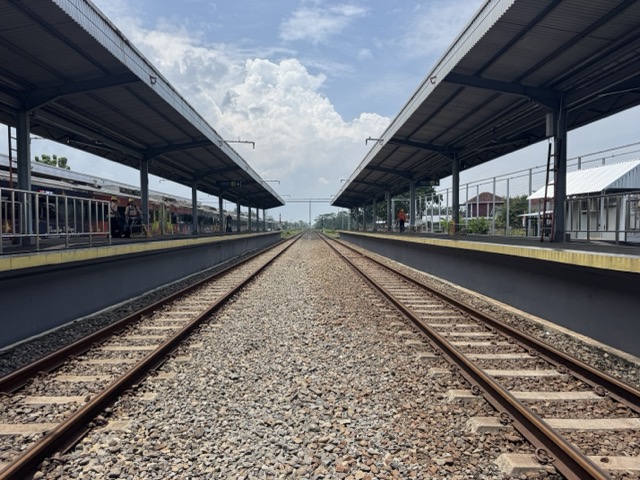

A Permaculture Course
Before I share these photos, I would like to encourage every single person reading this blog to find your local permaculture community/allotment or the like, and join them. Learn from them, connect with them, be part of their volunteering activities and help create and maintain your own local community garden. This course was run by a Brit who lives in Bali at the local farm (Kul Kul) where we lived.


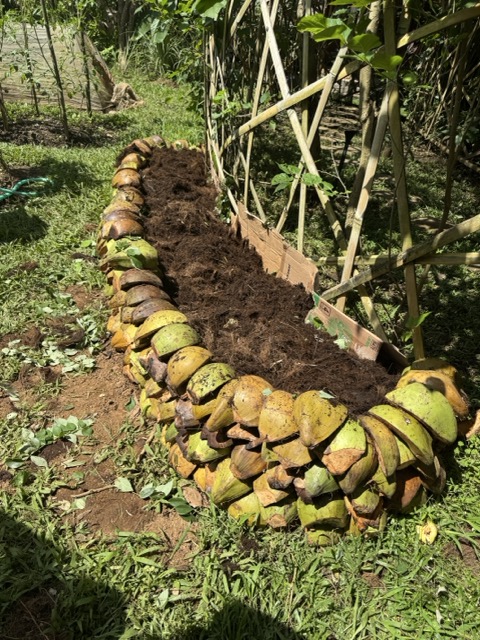


Life lesson : DON’T KNOCK THE DUNG!
Sibang – We love and miss you!


We can hear them move above our heads in the wind and some are lit up at night and look like UFOs

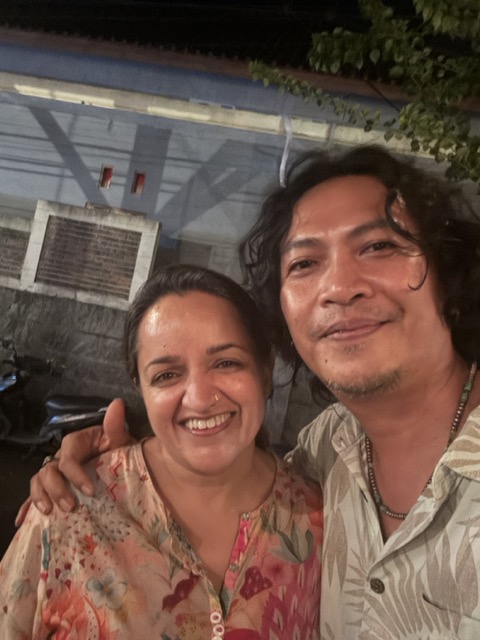


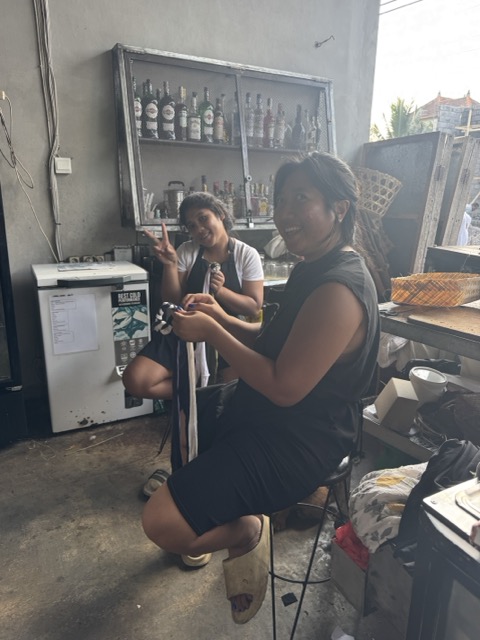


My key lesson from Amita, another wise woman
“It works, until it doesn’t“


She was back to her usual self the next morning.


Last year I created an event for mums leaving the school, which has now become a bi-annual event – for all mums in our community. It was my turn to leave so I’ve handed this batten over.


for some incredible yoga. If you would like to hear my interview with Rajiv (2 parts), listen in here


Spending time with friends like family in Bali


with the best cake ever!


Karaoke fun!

We will recommend Deyang to everyone!
Please support Tim and Yas in their incredible endeavours with the Tea Leaf Trust in Sri Lanka. They have and continue to do wonderful work!
Green School Events – Most of which were organised/facilitated voluntarily by incredible parents

I kid you not – this is an AI generated image of the future of Balinese Rice Farming. Makes you feel all warm and cosy doesn’t it? No … me neither. This challenging presentation made us all think, thanks to Tim from Astungkaraway. Many parents attend their regenerative rice farming course there and find it the most valuable experience of their stay in Bali.

I volunteered to support the following young people at school. All of them did an incredible job. I am in awe of all the children who presented their Greenstones, Quests and FootPrints. I’d like to acknowledge Leslie Medema (the old head of campus) for introducing this concept to the school. She didn’t get a mention, but richly deserves one.
My Greenstone highlights are not available online as they were presentations which required parental consent. Ralph and Kaya had the room in tears with their presentations on Eradicating Misogyny and a deeply traumatic personal experience (respectively).


I also took the opportunity to support Grade 12 (shown above) and Grade 8 by running a workshop on public speaking and presence. I never know if these things help, but apparently the feedback was good and ultimately they all did brilliantly! Ibu Jess needs a huge shout here. She mentors all of grade 8 and 12 students individually throughout the year and does an absolutely sterling job.

The school is incredibly fortunate to have teachers like Guru Andy and Ibu Laura in middle years. They genuinely care for their students and create an environment where children feel supported, encouraged, and valued.
As in any learning environment, experiences can vary depending on the individual involved. At one point, Anisa took the initiative to email a member of the senior team (whom I will refer to as “Glinda”) to ask whether she could speak at the whole-school assembly the week before her event on discrimination, much as other students had done to promote their own projects. We felt this was a brave thing to do.
The request was made on the morning of the assembly and was declined. When I asked why, I was told the subject matter only applied to middle and upper school – which was very much not the case – a primary school student was one of the key speakers. While there may well have been some logistical constraints that day, it was disappointing and not a convincing argument. The topic Anisa wanted to address is a very real one, and we would have loved to see a student-led initiative on discrimination given a wider platform.
At the time, I was frustrated by the outcome. However, I eventually realised that Anisa did not need that particular assembly slot in order to succeed. Looking back, my disappointment was less about the missed opportunity itself and more about a feeling that, after investing so much in her education there, her initiative and enthusiasm had not been fully recognised in that moment. Fortunately, others closest to her and their encouragement helped ensure that this setback remained just that: a small setback, rather than a defining experience.
During one conversation, Glinda remarked, “I’ve seen it all. Nothing will kill the Green School.” I found that an interesting perspective, particularly from someone who has been both a parent and a member of staff for more than a decade. It speaks to the resilience of the institution and the confidence people have in its future. At the same time, it made me reflect on the importance of succession planning and organisational continuity. Strong institutions endure not because they rely on any one individual, but because they nurture the people and systems that allow them to thrive over time.
One final observation: I later found out that staff members are required to sign non-disclosure agreements. I do not know the details or context behind this policy, and there may be entirely reasonable explanations for it. It was something that caught my attention and prompted me to think about transparency and trust.


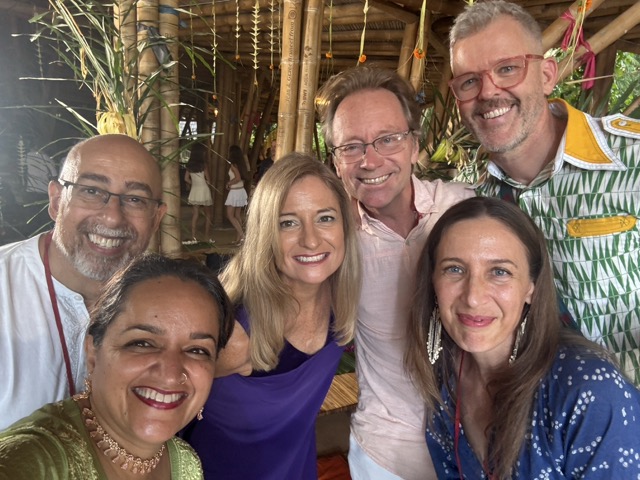
Some of the loveliest parents at the grade 8 graduation ceremony. Ian delivered a wonderful parent speech. Kurt (in the middle) had dengue and still showed up! As parents who had been here the longest and in their final year at Green School, I was hoping they would be asked to share a few words with the families. Sadly nothing.

The first Regen Conference at Green School was designed for young people from schools across Southeast Asia. “Regenerativity” is a current trending term, replacing “sustainability” on the basis that we no longer live in a world capable of sustaining itself. We need creativity and imaginations to run wild – particularly among children.
However, when a buzzword becomes the latest marketing strategy for an education environment, it can lose the depth of its original meaning. It risks becoming little more than branding.
What if something is truly regenerative? Is it controllable? Can it be shaped? Is it designed to serve human egos and measures for success? Or does it emerge naturally from the environment in which it exists and from the students who become the “generators”? Does it require thousands of dollars in investment to come alive? For me, the answer to that last question is a definite no.
A long-term resident and former parent once shared what seemed like a sensible strategy for any good school: hire exceptional educators, keep student numbers low, and focus on educational excellence. It makes perfect sense. Yet this does not appear to be the direction the school is taking. The priority seems to be growth – which is in line with modernity. More students. More enrolments. More revenue. More housing. Money matters, of course, but at what cost to the alignment of families and their values with the original intentions of the school?
When I think about what I imagined Green School to be, I picture something emergent and a little chaotic. Something that evolves, churns, and creates. A place where generative creativity sits at its core. A place guided by values that protect the planet and all living beings. I imagine children getting their hands dirty, planting trees, caring for them over the years, and leaving behind something real and alive. A tree, perhaps, rooted in the landscape and carrying part of their story. This feels especially relevant when trees are being cut down at an alarming rate in the village which hosts the school.
There is little need, in my view, for shiny new digital devices. A suite of MacBook Neos has recently been introduced, yet the environment already contains everything required for learning, experimentation, and innovation. The school’s Innovation Hub provides extraordinary opportunities for exploration, creativity, and play.
Is it because the world is watching? If so, how much should that matter? Shouldn’t the opinions of the children and the local indigenous and guest community matter more than external perceptions? Don’t these voices then cause more people to become interested in the school. A purely organic approach with voices closely aligned to with school’s original purpose. And is the world really watching? Perhaps. But it is also dealing with many more urgent concerns closer at home. Especially today.
Words, stickers, and slogans do not create meaningful transformation in a world that desperately needs it. Nor am I convinced that strategy alone does. Strategy often reflects an older business-school mindset that seeks to control and predict outcomes. A school – particularly one like Green School – should represent life itself: uncertain, alive, creative, and impossible to map out completely. And dare I say – Agenda-less!
At Green School, regenerativity has been simplified into four concepts: Sensing, Seeking, Shaping, and Storytelling. I think this framework offers valuable learning opportunities for both children and adults. Yet it raises important questions. Who gets to tell the stories? Whose voice is being heard? Does the school genuinely create the space for students to shape these narratives, or are they guided, consciously or unconsciously, by particular individuals, agendas, or even AI?
So what about AI?
This is one of the most fascinating and divisive conversations within the school community. Some parents have said they will leave if AI is not integrated into the curriculum. Their children are already using it at home, some from as young as 6. Others have stated they will leave if AI is introduced. The division is clear.
There were discussions about organising community-wide conversations to explore the issue together. As part of the GSPA, many of us hoped these dialogues would help shape a shared understanding. Unfortunately, they never fully materialised in the way we had envisioned.
Back to the conference. As a volunteer, I was particularly interested in hearing what young people themselves had to say about AI. Instead, I found myself attending a panel discussion featuring parents and a Green School alumnus, moderated by students. The panel consisted entirely of majority white AI enthusiasts.
I struggled to understand why parents were positioned as the central voices at a conference designed for young people. The community needed a conversation among its members; instead, the conversation was directed at the children.
As I listened, I felt both disappointed and uncomfortable with some of the messages being presented. In essence, the audience was being told :
– Elon Musk is someone children should aspire to emulate.
– AI-driven vehicles are safer than human drivers.
– Success requires children to excel at public speaking, sport, music, and AI.
Even if some of these claims contain truth, context matters. In Bali, many local families earn their livelihoods through driving services such as Gojek and Grab (think uber). Is a discussion on AI cars appropriate without acknowledging those realities?
Likewise, what about children who do not naturally excel at public speaking, sport, music, or technology? Are they somehow less successful? Less valuable? Surely not.
At this point I left.
Several staff members and parents later expressed similar concerns about the message being communicated. I asked Glinda who had selected the panel speakers. She confirmed that she had chosen them. I still find myself wondering why these voices were selected for a conference positioned on a global stage.
Later, I learned that several high-school students, many of whom were sceptical of both AI culture and “tech bro” narratives, had boycotted the conference. They felt excluded and disconnected from the event’s direction, which explained their absence. Also while schools from other parts of Asia attended with such enthusiasm, our children seemed bored and uninterested. Perhaps it’s because they were in their usual school environment? Perhaps they wanted more engagement and could have been given more responsibility? There’s learning in this too.
Ironically, the conference mascot was reportedly created using AI. Yet Green School is filled with extraordinarily talented young artists. Was AI really necessary? While we were there some project advisors actively encouraged students to use AI too.
I want to be clear: I am not judging students or teachers for using these tools. AI presents challenges for every school in the world. Green School is no exception. Teachers are doing their best to navigate a rapidly changing landscape.
My question is different. Is this aligned with the Green School ethos? And if it is, why not say so openly? Honesty costs nothing and creates trust. Nothing is perfect. Trying to satisfy conflicting parent expectations without a clearly articulated position risks creating confusion and assumptions. The school needs to define its relationship with AI and communicate it consistently – even if it’s changing. Since writing this, I have heard that the school now prefers an analogue approach – which is what the majority of the students want.
The ethical questions surrounding AI are worth examining critically. The technology raises profound questions about power, responsibility, equity, and the future of humanity. These conversations deserve careful attention rather than blind enthusiasm.
One documentary that explores some of these concerns left a strong impression on me. Whether or not one agrees with its message, it highlights the importance of engaging critically with the narratives surrounding technological progress – particularly now.
Before leaving the school, I had a conversation with a wise Balinese member of staff. She told me that despite the challenges and tensions that emerge within leadership structures, it is the teachers who hold the school together. I think she is right, yet some children will sadly still slip through this net.
Anyway, back to the updates…


Rumble in the Jungle – photo of the GS Parent Association (GSPA) who planned the event led by Astrid (Fredy is missing in the pic).
It has been such an honour to plan and organise with you all!
If the community supporting the school didn’t exist – it would not be anywhere near the school it is.

The parent choir performed straight after the grade 12 graduation ceremony. There had been some incredible choir leads before we joined the school and having been part of the community choir in Highams Park, I knew we needed one while we were in Bali. It was wonderful. A huge shout out to MarianA for leading!

A short summer in the UK
We came back to the UK after finishing up in Bali and spent cherished time with family. I’ve missed them so much – especially my dad and my beautiful mum (rest peacefully, Umey).
But there was one invite I wanted to honour – The Edge reunion.
As always I learnt so much from everyone in the room – especially the speakers. Thank you Kim for holding such an important space for those who are affected by the times we live in. If anyone reading this is an activist and struggling with current times, please reach out to Kim for a conversation. “The Edge” may well be what you need.


I highly recommend reading her book : I eat the stars. Facts, Science, wisdom – it has it all.


Anisa and I happened to pass the ‘Dream Experience” while getting some admin done in London. Unplanned and timely.


We hope you enjoyed following our journey so far, and perhaps gained some inspiration from our updates.
Let us know if you have any questions in the comments, or email and we can arrange a conversation over zoom.
Much love from the three of us xxx
2 Comments
Wow, what a dazzling amount of beautiful pictures, adventures and what a wonderful Journey. And Anisa is developing into a beautiful young woman, what a gift. Stay well, stay safe. Here we are gratefully enjoing being a grandfather and grandmother for Micha, the son of Tsjalline and Yasser. Big hugs, Annemie.
Thank you, Annemie. I am so glad you are enjoying being grandparents for Micha. What a blessed little boy. They grow so fast, I know you will be enjoying every moment. We have fond memories of Tsjalline and Yassers wedding 🙂 Big hugs from us too! x